Verified records arrive from integrated systems, registries, partner platforms, and connected business tools.
Neutral revenue ecosystem concept
Revenue systems become stronger when data can connect, reconcile, and explain itself.
FiscalMesh is a Revenue Interoperability & Compliance Intelligence Ecosystem that connects business systems, payment touchpoints, onboarding flows, and institutional dashboards without positioning itself as a replacement for existing core tax administration platforms.
Missing, new, or update-required customer information is collected through guided onboarding workflows.
Reconciliation, risk signals, alerts, intervention queues, and executive dashboards become measurable.
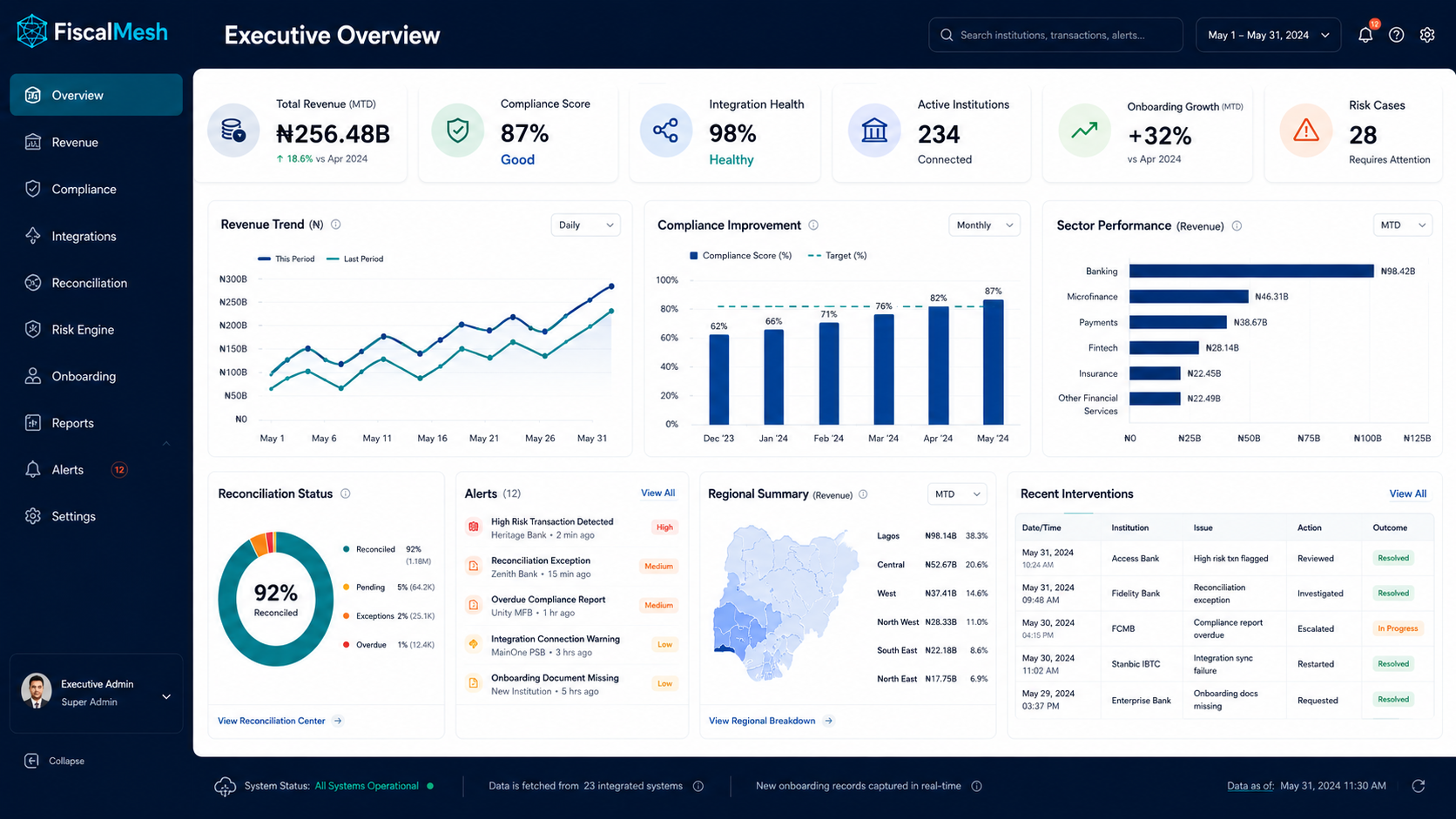
Executive Command Center
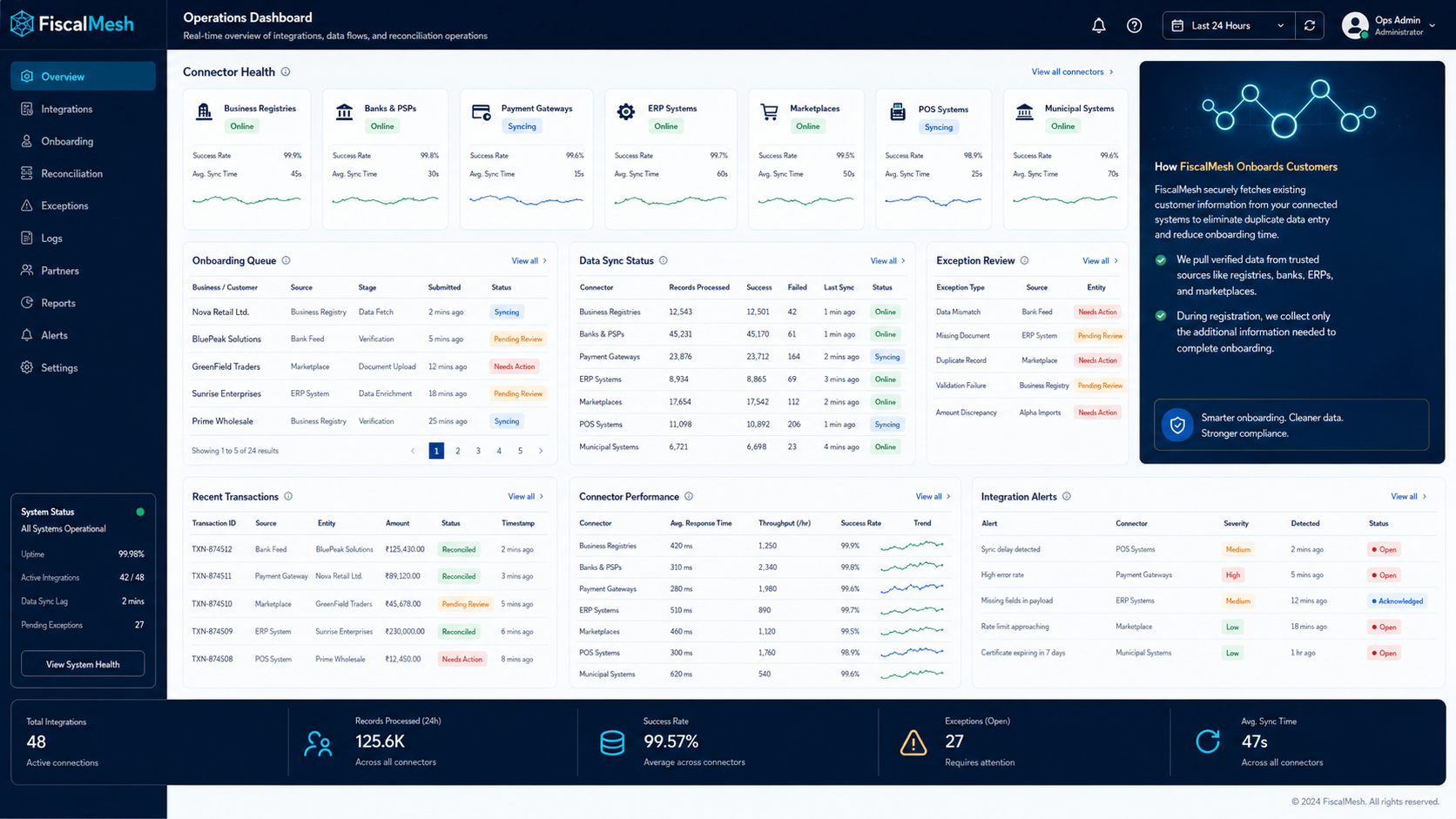
Integration Operations
98%
Integration health
72%
Faster onboarding
1,842
Compliance alerts
How FiscalMesh works
A clear data journey from integration to institutional action.
This is the product story that should remain visible throughout the landing page: pull verified existing data, capture new onboarding data where needed, validate it, reconcile it, and convert it into decisions.
Connected Sources
POS, PMS, ERP, registries, payment gateways, marketplaces, sector tools, and field channels.
Record Fetch
FiscalMesh retrieves existing business and customer records to reduce duplicate capture.
New Onboarding
Only missing or newly required fields are captured with guided forms and role-based workflows.
Validation & Reconciliation
Transactions, records, receipts, and source systems are compared for consistency and exceptions.
Risk & Alerts
Priority cases, mismatch signals, delayed updates, and compliance heat indicators are generated.
Executive Insight
Decision makers see dashboards, pilot metrics, intervention history, and performance trends.
Why it is compelling
It solves the visibility gap around systems that already exist.
FiscalMesh should feel like an ecosystem layer, not a basic tax dashboard. Its strength is the space between business activity, connected systems, onboarding, payments, reconciliation, and institutional intelligence.
Boss-level positioning
“FiscalMesh helps revenue institutions connect external transaction evidence, onboarding records, and compliance signals into a single intelligence layer for faster review, cleaner reconciliation, and better decision making.”
Centralized visibility
One strong narrative across systems, jurisdictions, partner data, and operational dashboards.
Interoperability first
Designed to work with existing platforms through connectors, APIs, certification, and data mapping.
Reconciliation intelligence
Turns data matching and exception review into a visible product capability, not a hidden back-office task.
Explainable risk action
Shows why a case is flagged, what evidence exists, who should act, and what was resolved.
Smarter onboarding
Fetch first, capture second. New data is requested only where a record is missing, incomplete, or new.
Sector-specific packs
Hospitality/PMS, POS retail, marketplaces, digital services, and payment intelligence can be piloted separately.
Core modules
The landing page now sells a real ecosystem, not just screenshots.
Each module can be discussed as part of an institutional pilot, partner integration, or executive product demonstration.
Integration Gateway
Connectors, API registry, webhook monitoring, partner certification, payload validation, and adapter health.
Data Fetch & Profile Enrichment
Existing customer records are synced before any new data collection begins.
New Onboarding Capture
Guided business and customer onboarding for new or incomplete records.
Reconciliation Engine
Matching across receipts, declarations, payments, transactions, and external source systems.
Compliance Risk Intelligence
Signal scoring, anomaly flags, evidence trails, case queues, and intervention tracking.
Executive Dashboards
Revenue visibility, integration health, sector performance, compliance score, and KPI drill-downs.
Field App
Mobile onboarding, receipt scan, assisted verification, taxpayer lookup, and offline sync status.
API, USSD & Assisted Access
Useful where institutions need both web-based integration and lighter digital access channels.
Audit Trails & Evidence
Change history, action logs, case notes, update evidence, and product trust.
Dashboard system
Visual proof across leadership, operations, and field workflows.
The interface is presented with clean breathing room so stakeholders can immediately understand what each screen does and how the ecosystem supports decisions.
Desktop dashboard
Executive Overview
Revenue trends, compliance score, integration health, regional performance, risk cases, and recent interventions.
Web operations
Integration & Operations Console
Connector health, onboarding queues, data sync status, exception review, recent transactions, and source monitoring.
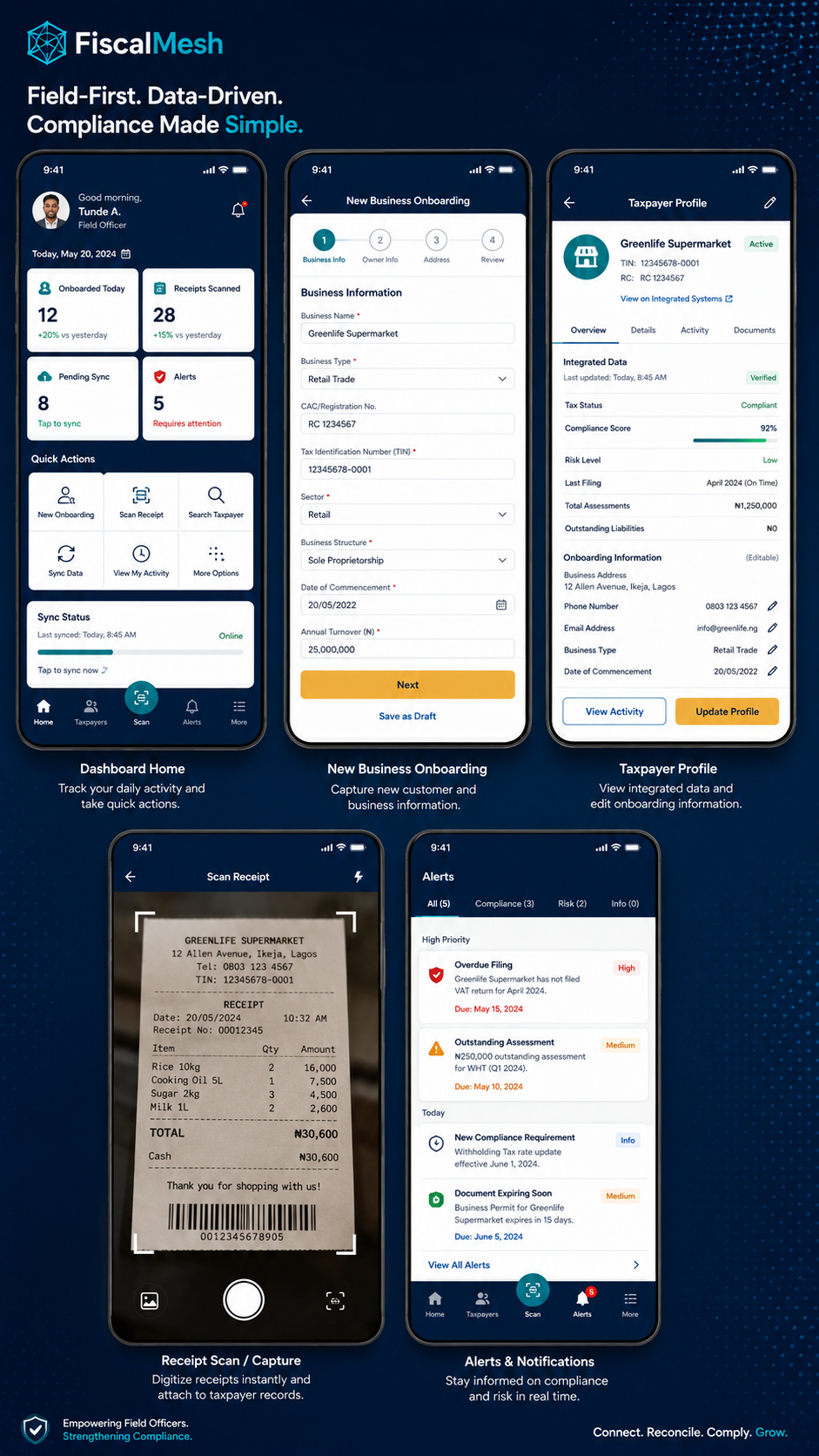
Mobile field app
Onboarding, scan, profile, alerts
A field-ready mobile layer for new business capture, taxpayer record lookup, receipt digitization, and sync visibility.
New onboarding
Receipt scan
Risk alerts
Strategic placement
Not a replacement for existing tax systems, but a productivity layer around them.
FiscalMesh is positioned like a smart bridge between daily business activity and formal compliance workflows. It helps users organize records, prepare documents, monitor obligations, validate data, and become ready before interacting with existing official platforms.
Existing systems remain
Official registration, filing, payment, and statutory decisions stay inside authorized platforms.
FiscalMesh fills the gap
Businesses get guided readiness, record cleanup, reminders, document checklists, and AI support.
Centralized visibility model
Inspired by global digital administration trends: connected evidence, structured data, and simpler reporting.
Integration-ready
Future APIs can connect POS, ERP, marketplaces, payments, e-receipts, and approved institutional services.
Request Demo Access
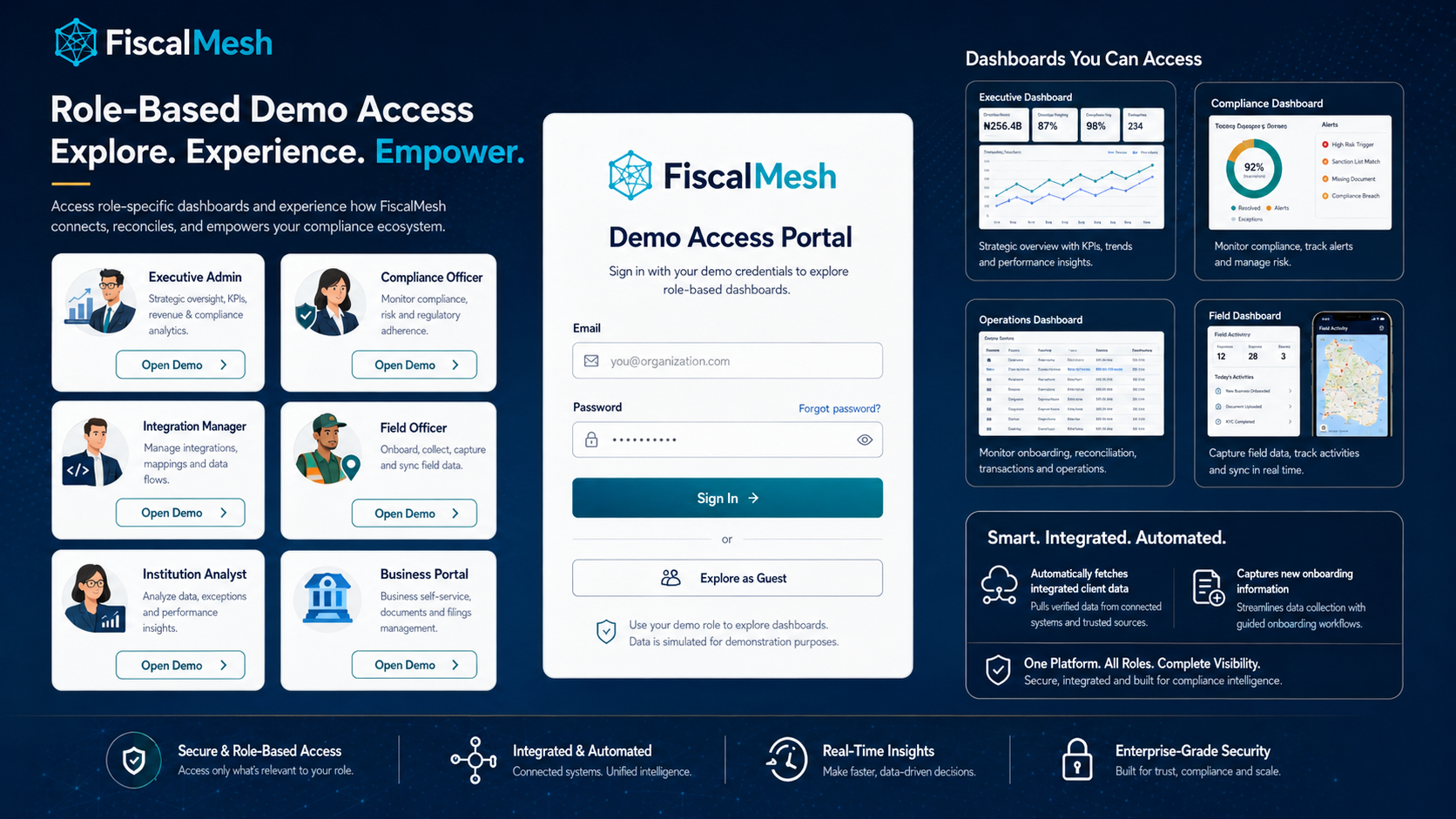
Request private access, then review only the dashboard assigned to your role.
The demo portal is built for serious product conversations. Credentials are not shown publicly; approved reviewers receive role-specific access so each stakeholder sees only the right dashboard.
Executive Admin
Strategic KPIs, revenue visibility, institutional performance, and decision intelligence.
Compliance Officer
Risk cases, alerts, compliance signals, interventions, and evidence-backed review.
Integration Manager
Connectors, data fetch, API health, partner systems, PMS, POS, and ERP flows.
Field Officer
Mobile onboarding, receipt scan, taxpayer lookup, verification visits, and sync activity.
Institution Analyst
Sector analysis, exception patterns, trend reporting, data quality, and pilot metrics.
Business Portal
Business self-service, profile review, onboarding completion, and document status.
Presentation-ready narrative
FiscalMesh now looks more credible, more premium, and more institution-ready.
Use it as a stronger first impression before presenting the role-based dashboards, pilot logic, and partnership story.